Latest News & Updates

Youthlaw statement on proposed bail reform laws

The Victorian government intention to introduce harsher bail laws is not smart or evidenced based.  Stricter bail laws will not make the community safer. It will not reduce crime.  

Many media outlets have been professionally irresponsible producing alarmist rand exaggerated reporting of youth crime. They have stoked unnecessary fear in the community and concerns for safety.  Adding to this is the politicisation of youth crime, by both the major parties who see it as their path to government.  

We all want the same thing – children and young people not committing crimes in the first place and everyone safe in their homes.  

Stricter bail laws are not an effective deterrent for children and lead to more time on remand and more offending, rather than less. The recent Criminal Justice Inquiry and the Yoorrook Commission, to name only a few inquiries have, have provided ample evidence of the damage done by harsh bail laws and the alternatives.  

We need to focus on giving young people and their families the support they need to avoid offending behaviour in the first place. This means better support in schools, in communities, for mental health and addressing cost of living pressures. It also means stopping the scourge of family violence and keeping young families safe in their homes.   

  • The biggest criminal offence being committed in Victoria is family violence. In most Victorian LGAs, the number of IVO breaches alone far outweighs the number of young people committing crimes.   
  • The biggest spike in crime over recent years has been car and shop theft that are typical crimes of disadvantage.  
  • We also need to focus on older adult criminal networks that continue to recruit kids.   

It costs $7775 a day to lock a young person up in Victoria – and this money is going to the wrong end of the problem. We need to wrap this money around families, schools, mental health clinics and more.   

Front line organisations that are working with these young people on the ground need a seat at the table in designing the response – no such organisations were consulted in these knee jerk reactions from the Victorian Government – this is the fourth time this same government has gone back and forth on their bail laws, it is clear they need input from all over the state to find the right answer.   

The Government also needs to commit proper funding to its Youth Justice Act to be properly implemented across all of the supports like schools, families, health professionals, employers and more.  

As a community we also need to take responsibility for the fact that overwhelmingly repeat youth offenders have been victims of crimes themselves (sexual abuse, family violence, neglect etc) and/or have cognitive disabilities and they or their families have been inadequately supported or cared for.  We need to put support around them and their families in the earliest moment in time, rather than locking them up and failing them again.  This is what works and will ensure they have the best chance at a good life where they can contribute to community and what will keep our communities thriving and safe. 
 

What is really going on with Youth Crime? 

What is really going on with Youth Crime? 

Youth Crime has long been a hot button topic in the news cycle. There is fear mongering, sensationalism and general misrepresentation of statistics to paint the picture of a country in crisis, with youth running wild and making us unsafe in our homes. 

But how accurate is this picture? And what does fear mongering achieve? Is there a better approach to preventing youth crime? 

The data 

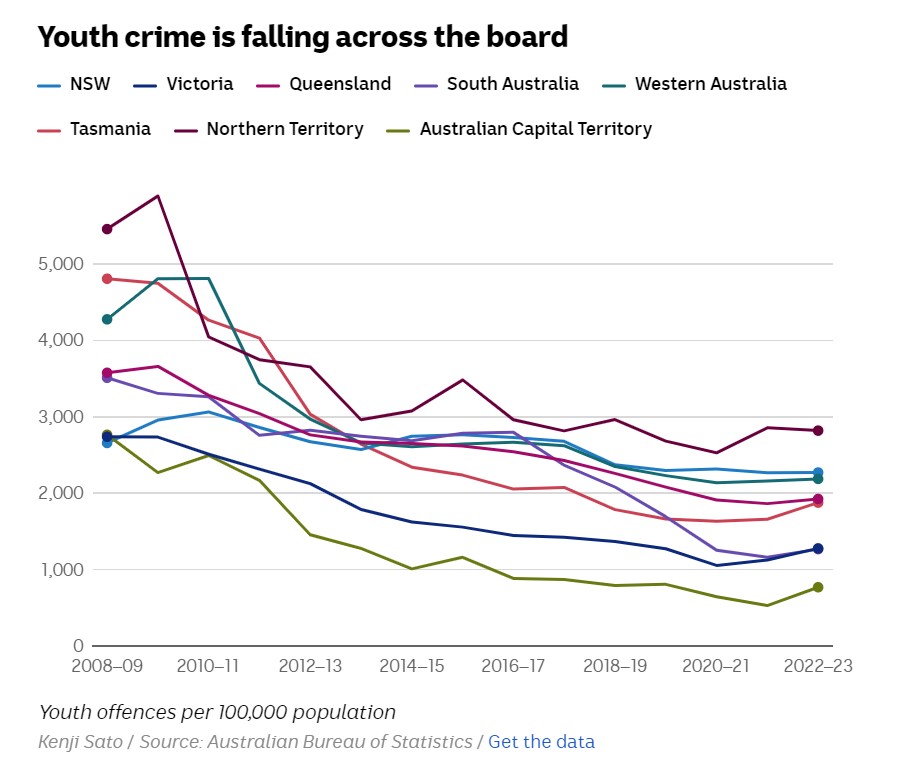
Youth crime rates are falling across the board in Australian states and territories and have been falling for more than a decade.  

(Data from Criminologists debunk claims of ‘youth crime crisis’ as data shows dramatic declines – ABC News) 

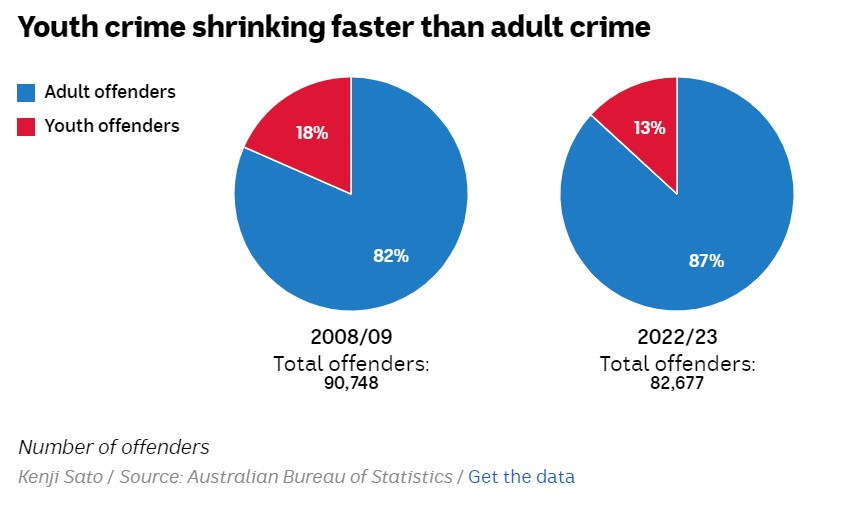
 There is also data which shows that youth crime is reducing faster than adult crime, throwing the narrative that youth crime is the biggest threat to our safety on its head. 

(Data from Criminologists debunk claims of ‘youth crime crisis’ as data shows dramatic declines – ABC News) 

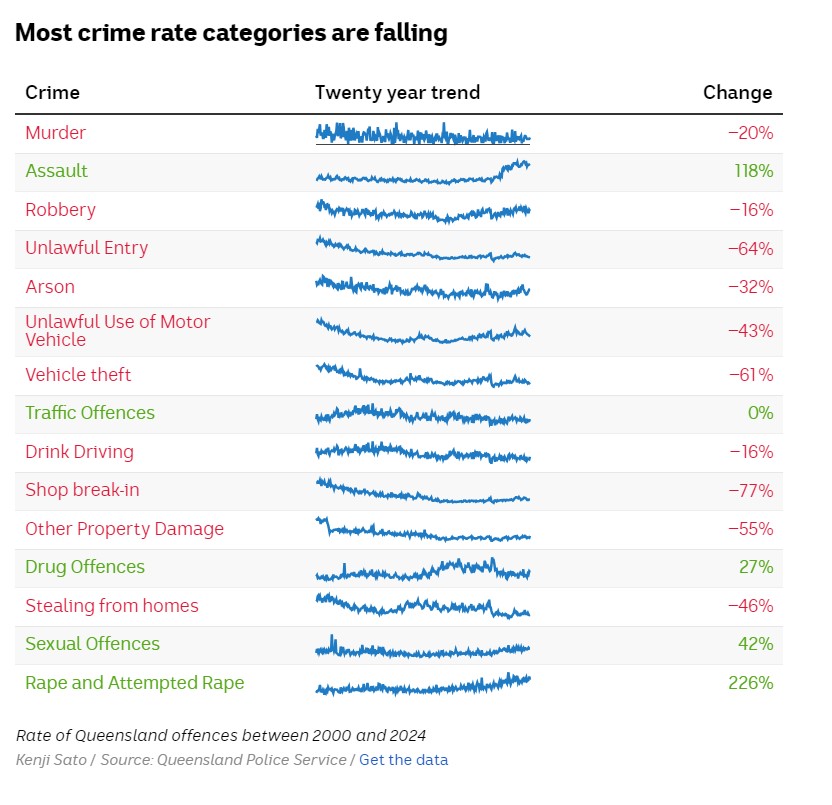
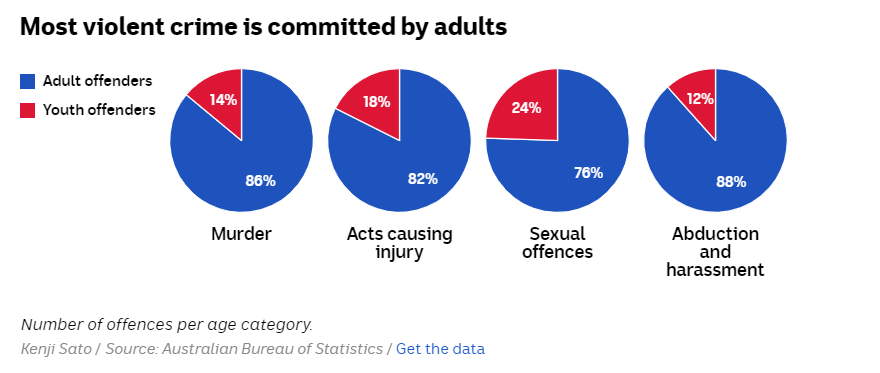
The data shows that in relation to Queensland there has been significant decreases in a number of crimes with notable exceptions including rape, domestic violence and assault. What is also notable is that the vast majority of these kinds of violent crimes are committed by adults. 

(Data from Criminologists debunk claims of ‘youth crime crisis’ as data shows dramatic declines – ABC News) 

(Data from Criminologists debunk claims of ‘youth crime crisis’ as data shows dramatic declines – ABC News) 


What does fear mongering achieve? 

When the news reports on youth crime as if it is increasing at rapid rates, that it is getting more prevalent and more violent, it leads to harsh and draconian policy responses which we can see occurring in different Australian jurisdictions. 

  • The LNP in Queensland has promised to deliver harsher penalties to youth offenders with the slogan “adult crime adult time” becoming the centrepiece of its election campaign. 
  • Labor in Queensland has watered down detention as a last resort protections, toughened youth bail laws and promised to built more youth detention centres.  
  • Victoria has reneged on its promises to reinstate the presumption of bail for under 18s and to raise the criminal age of responsibility to 14.  
  • Northern Territory has gone entirely backwards and is looking to reinstate the criminal age of responsibility as 10 years old. 

As the data indicates, the reality facing us is that while the population has continued to grow, we have actually seen the number of offences stay the same or decrease in certain areas. There is no increase in youth crime which is supported by the data. 

The ABC discussed the matter with Griffith University criminologist Ross Homel who said that the idea that harsher penalties would reduce youth crime was a lie perpetuated by the major parties. He said that the opposite has been repeatedly demonstrated through twin studies, randomised controlled trials, natural experiments and longitudinal studies, “criminal justice processing of juveniles is itself a cause of future offending. It doesn’t make the community safer.” 

The popular punishment-based policy approach fails to address the underlying causes of youth crime, which include neurodevelopmental disability, sexual or physical violence, poverty and low education.
 

Is there a better approach? 

Neurological and other scientific studies on children show that their brains continue developing even up to the age of 25, and this makes children and young adults prime candidates for rehabilitation. We know that early intervention and working with communities improves outcomes for children and the community. Preventing children from entering into the criminal justice system, prevents them from becoming entrenched in the system and potentially becoming repeat offenders. It is at this point that they become increasingly dangerous to the community. If we focus on early prevention, and diverting children away from the criminal justice system, we are giving them a better chance to rehabilitate and become productive within society and protects the community better in the long-term. 

Youthlaw’s submission to the Senate Legal and Constitutional Affairs Committee’s inquiry into Australia’s youth justice and incarceration system.

The government recently announced that there will be an inquiry into Australia’s youth justice and incarceration system.

As an issue which impacts many of the young people that we assist.

We prepared a submission for the Committee to consider which covers the impacts of recent changes we’ve seen (both positive and negative), issues we see on the ground, and our asks of the Committee.

Please see a full copy of our submission here.

Youthlaw calls for support for the Youth Justice Bill 2024


The Victorian Youth Justice Bill 2024 will be presented to the upper house in Vic. Parliament during the next few weeks

We support the Youth Justice Bill. We regard it as a very important opportunity for significant change to youth justice in Victoria.

Main purposes of the Bill are to:

  • Raise the minimum age of criminal responsibility from 10 to 12 years of age
  • Ensure oversight and accountability of the Youth justice (YJ) system to
    • Promote safety
    • Prevent and reduce children’s and young people (YP) offending
    • Support the rehabilitation and positive development of children and YP involved in the YJ system
    • Provide victims with appropriate opportunities to participate in the YJ process
    • Protect the rights of children and YP involved in the YJ system
  • Establish a new hierarchy of options police must consider, pre-charge and at all stages post charge including using
    • Youth warnings and youth cautions
    • Early diversion group conferences
    • Court ordered diversion from criminal proceedings

The Bill sets out very clear steps and considerations for the police and magistrates that educate and guide them in their decision-making. They must now consider a young person’s trauma background and being from an overrepresented cohort in the criminal justice system (e.g. Aboriginal and Torres Strat Islander, out of home care background, multicultural youth and young people with mental &/or physical disability).

The Bill includes principles and considerations specific to Aboriginal young people across the youth justice system through specific guiding principles, sentencing principles, custodial principles and rights. The Bill includes a statement of recognition in respect of Aboriginal children and young people, acknowledging; Aboriginal children and young people are over-represented in the youth justice system, particularly in custody, and that ; Inequality, and structural and institutional racism, caused by colonisation and laws, policies and systems which explicitly excluded and harmed Aboriginal people and culture, have led to this over-representation and the continuation of systemic injustice.

The Bill raises the Age of Criminal responsibility to 12. This is informed by the evidence that the current age is damaging to these young people, and a non-criminal response is required to address the needs that underly offending.

Specifics of the Bill in relation to the new pre-charge & post charge laws are:

  • The Bill sets out a new hierarchy of options police importantly, now must consider, before ultimately charging a child (these are taking no action, issuing a warning, issuing a caution, referring the child to an early diversion group conference to commence a proceeding).
  • At each step, police need to determine it is ‘clearly not appropriate’ before considering the next option in the hierarchy. This places positive obligations on police to consider each option and refer to certain criteria. (e.g., police must consider the nature/seriousness of offending etc.).
  • Police also must record reasons if a warning caution or early diversion group conference isn’t appropriate.
  • The fact that a young person has had one before doesn’t preclude them having another.
  • Nothing prevents a warning or caution being made after charges are laid, which means the court may be requested to withdraw charges in circumstances where the failure to caution or warn was clear.
  • The pre-charge options will not be noted on a child’s criminal record.
  • For ATSI children, an elder can give a caution, if consented to, at a culturally appropriate location. The latter will avoid the current practice of cautions being issued at police stations.
  • The pre-charge diversion group conferencing option excludes some types of offences but is well thought out. Young people must have legal representation too, which is good. If a child is charged, and the court considers the pre-charge group conferencing is appropriate they can make a referral for the child to do this. They must consider police submissions, but the magistrate ultimately decides.
  • Post charge diversion is provided for and consolidates current practice. It retains Victoria’s successful court-ordered diversion program, the Children’s Court Youth Diversion (CCYD) scheme, with updates to its eligibility criteria to reduce barriers to participation.
  • Children will be able to access treatment and rehabilitation programs while on bail or remand. This is currently not available and is a missed opportunity to respond to these young people’s needs.
  • There will be greater guidance and emphasis on deferred sentencing. Currently this is under utilised as a sentencing option. It provides an opportunity to link the young person to services and supports they need. The Bill clarifies the circumstances under which a sentence can be deferred and requires the court to explain to a young person how their behavior during the deferral period could impact their sentence.

Youthlaw calls for the following amendments to the Bill

Without the following we still support the Youth Justice Bill being passed.

  1. We oppose the prosecutor having to agree to diversion. This is the current law and practice, and we observe regularly a lot of inconsistency and subjective prejudice in the making of such decisions. We strongly support an amendment to the Bill that requires the prosecutor’s view be sought but the magistrate ultimately decides.
  2. We believe that the Age of Criminal Responsibility should be raised to 14. The government’s position is to develop an alternative service model before raising the age to 14 by 2027.  We will continue to work with the government on this alternate non-criminal response.
  3. We believe the minimal age of detention should be 16. The Bill proposes 14.  It is our position that detention is not a place for young people under 16, is damaging and negatively disrupts their development including schooling.  Our position is also informed by the evidence that children in detention are overwhelmingly from overrepresented cohorts including ATSI children, children who have been in child protection or have traumatic backgrounds and children with disabilities.
  4. We do not support the introduction of electronic monitoring bracelets.
  5. We support removing the reverse presumption for bail (and funding of suitable bail support programs) for children. Last year the Government signaled its intention to include this in the Bill